1907 - The Course of the Romanian Uprising


In spring 1907 a devastating peasant uprising engulfed the fledgling Romanian Kingdom, shook it up from its very foundations and made a mockery of its strenuous, decade-long efforts at projecting the image of a civilized modern state. The uprising was (and still is to date) the most violent and destructive episode in Romanian history ever to occur in peacetime (not even the 1989 revolution killed as many and destroyed as much). Although at its peak the uprising only lasted a couple of weeks, it engulfed the whole country, threatened to destabilize the state and saw extremes of violence perpetrated on the part of both the rebellious peasants and the repression army. The conflict was only suppressed by using heavy artillery against diehard peasant bands. 

This is a brief post musing on a historiographical commonplace about the uprising: that the troubles broke out in the north of the country, close to the Russian border. This was indeed the case, but with an important caveat. The set of maps above chart the course of the uprising on the basis of extant correspondence between regional and central authorities. The colour code is the following:

- BLUE denotes relative calm, no out-of-the-ordinary incidents (or at least no reports to this effect)
- PINK refers to inceptive unrest: demands, complaints, threats
- RED is for acts of physical violence: destruction of property, arson, beatings, killing

Even allowing for fragmentary evidence and archival bias, it is fairly clear that by February the whole country was in ferment. The fact that it was in the northern counties that the first acts of open violence were registered becomes in this context almost anecdotal. Given that the state of discontent reigning at the time among Romanian peasants was so high and so widespread, the spark could have occurred anywhere else with the same effect (in 1888 a similar uprising broke out in the south, but lack of synchronisation with the north of the country prevented it posing an equal threat). 

Why is it important to note this? Why does it matter where it all started if the outcome was the same? 

It matters because, by focusing on the north of the country, contemporaries and even some later historians came to endorse two myths: 

(1) that the uprising was a consequence of merciless exploitation by Jewish leaseholders. 
    
Lessees of Jewish faith did indeed dominate the land rental market in Moldavia, but a look at the leasehold system in Wallachia shows it to have been equally oppressive with almost no Jewish leaseholders.  As Prince Urusov, the governor of Bessarabia, once said about the similar leasehold system in the Tsarist province: it was not the Jews that were particularly exploitative, but the system itself, which was happily practised by all confessions alike. Moreover, it was in Wallachia, where there were hardly any Jews, that the uprising got particularly savage and not in Moldavia.

(2) that the proximity to the Russian border had something to do with the uprising: contamination, Russian revolutionary influence.

There is sporadic rumour in official correspondence of strangers, allegedly Russian agents, roaming the countryside, but no conclusive evidence exists of genuine Russian contamination. The Romanian authorities were convinced that foreign foul play was at work and that the peasants would never have risen of their own accord. This, just like the first myth, shows the disconnect of the authorities from the realities on the ground and is one of the reasons the uprising failed to be put down in its early stages: the government were barking up the wrong tree.

A BOOK OF RIOTS

or my collaboration to the AHRC-funded Research in Translation project

View Exhibit Here


How do you communicate your post-doctoral research to an 'intelligent 12-year-old'? Without dumbing it down, without stripping it of its complexity, without oversimplifying it out of all recognition? How can you translate it into a medium other than the printed word? How can you make it interesting to an audience that doesn't automatically take an interest in the topic? These were the questions and the great challenges implicit in the project Research in Translation: public engagement through exhibition displays jointly organised by Dr Ceri Jones (University of Leicester) and Dr Serena Iervolino (UCL Qatar) this year at the School of Museum Studies, University of Leicester. 

You've spent a decade or so deepening your research, honing down your academic style, taking in the latest, subtlest theories on the subject, juggling with great variety of sources, seesawing between methodologies, quibbling over nuance of argument. Now forget all of these, step down from your Academy of Laputa and face the real world for a change. 

The Book of Riots I submitted to the exhibition relies on a simple dichotomy: the disparity between what officials thought about various riots (causes, motives, triggers, culprits) and what actually happened on the ground. For more topicality and relevance to present-day concerns, I embedded my own research material (regarding peasant uprisings at the beginning of the 20th century) within a triad of riots: 1907 peasant uprising in Romania, 1967 Detroit riots and 2011 English riots. One could not think of three more disparate events and yet a basic commonality of riot management dynamics is there in all three of them. Each of the three was misread by the authorities of the time, each of them had a rationale of their own, in glaring contrast to what the authorities thought was happening. 


The actual exhibit consists of a book briefly describing each of the riots, and audio files which reenact the voices of the rioters based on extant documents of the time. In other words, these voices are not fictionalised, they are dramatised primary sources, snippets of archival material, sociological inquiries, interviews. 

Here is a draft sample of the 1907 voices of peasant rebels in Romania. Apart from the main narrator voice (Karina Fernandez, who kindly agreed to lend us a hand), none of the others are by professional actors:


Apart from text and audio, the display needed a catchy introductory poster, which, as we were told during the training sessions, was meant to attract attention to the exhibit, draw the visitor in, 'hook' them in. This, like the rest of the exhibit, underwent a metamorphosis from initial concept and my own wonky sketches: 


to trying (and failing) several times to find a professional illustrator and, finally, through a stroke of luck and Facebook vagaries, finding a great up-and-coming young illustrator, Alexandru Săvescu, who was able to take this on and translate it into professional drawing:


Working on the Book of Riots has been a great learning experience: trying to pitch a visual and textual message so that a museum audience can comprehend it and take interest in it may seem, on the face of it, a piece of cake. You find, when you are actually doing it, it is anything but that! It is not about dumbing down information, but rather about making it accessible (was it Voltaire who said that if a message cannot be translated, then maybe it is not worth translating in the first place?), communicating vital notions and experiences to non-specialists and feeding them into the public mainstream of ideas. Whilst the exhibit itself can no doubt be improved and refined further, the experience gained in putting it all together remains invaluable.


A big Thank-You to all of those involved in shaping this exhibit: the two organisers, Ceri Jones and Serena Iervolino, who have put a tremendous amount of work into this exhibition and have been most helpful every step of the way; my kind and patient mentor Pippa Sherriff; all the workshop participants and presenters for their useful, thought-provoking comments and suggestions; Maureen Duke (the bookbinder, who made a great effort to help when I ran out of options); my impromptu audio voices Karina Fernandez (the only pro in the cast), Amy Samuelson, Jason Vaughn and Daniel Brett (who reminded me what friends are for); and Alexandru Săvescu (the illustrator).

Last but not least, my gratitude goes to the Leverhulme Trust, which provided additional financial support for my exhibit.

Footnote to the Exhibit:

- the script for the audio recordings is based on genuine interviews and primary sources:

1. for the 1907 Romanian Peasant Uprising I drew on Oțetea et al., Documente privind marea răscoală a țăranilor din 1907, Editura Academiei RSR, București, 1977-.

2. for the 1967 Detroit riots I'm quoting material from Max Arthur Herman, Summer of Rage: an Oral History of the 1967 Newark and Detroit Riots, New York, Peter Lang, 2013.

3. for the 2011 English Riots I used the Guardian and London School of Economics Report (many thanks to Gavin Bailey for pointing it out to me).


In Search of Hungarian Archives


Mapping official reactions to a contemporary crisis should theoretically be fairly straightforward. You draw a chart of concentric circles starting from the top of the hierarchy and gradually descend down to the regional and local levels, then track down the corresponding archives. Press coverage and diplomatic exchanges are the easiest to get hold of. I am currently drawing up a synopsis of reactions across the Austro-Hungarian border to the 1907 peasant uprising in Romania. Were there any reactions? Why would there have been any in the first place?

Several brief reasons:
1) basic self-preservation reason: if your neighbour's house is on fire, you are likely to wonder if the fire is going to spread to yours as well.
2) demographic reason: almost 3 million Romanians lived in the Hungarian half of the Monarchy at the time, for the most part concentrated along the eastern border, i.e. the border with Romania (the Romanian population was among the poorest);
3) some commonalities of land tenure:  latifundia system and periodical peasant unrest
4) nationality politics: what did the virtual implosion of the Romanian state teach the political leaders of Hungary, both those belonging to the Hungarian ruling class and the political leaders of the non-Magyar nationalities?
 ***
The longest stretch of the border with Romania was part of the Hungarian half of the Monarchy. This could only have been a reason for joy on my part as the Hungarian state possessed at the time a comparatively well-organized policing system, informers' networks, a solid and effective system of keeping tabs on the population. This was the result not just of post-Ausgleich Hungarian state-building, but also the Habsburg legacy of Polizeistaat going back to Metternich and Joseph II. In other words, this state had better 'eyes' than the others across the triple border.

So I thought to myself: Budapest archives, here I come!

The first surprise was to find in the Cluj archives in Romania a hefty holding (fond) entitled 'Royal Hungarian Ministry of the Interior'. The final number below refers to the number of archival units in this fond (a unit can be anything from a one-page to a hundred-page folder). What I found even more encouraging was that it covered the entire post-Ausgleich period.


My enthusiasm was short-lived as I soon found out that the holding is currently unavailable for research: it hasn't been catalogued yet and it is part of a long backlog of uncatalogued material. Never mind, who needs to look at facsimile copies of the Hungarian archives? I'll go to Budapest and get my material straight from the horse's mouth. This is where I made the second discovery. What the Romanian archives are in possession of are not copies or facsimiles or microfilms. They are THE REAL THING! The Cluj fond seems to be part of the original archive of the Royal Hungarian Ministry of the Interior which ended up in Romania as war booty taken by the Romanian army in 1919.

This also comes out of the information provided by the Magyar Országos Levéltár in Budapest: part of the archive was taken by the Romanian army and part of it was damaged during revolution and war.


Now, where do I go from here? The archive which promised to hold the most thorough population surveillance reports is not in one piece and the most relevant splinter is off-limits.

Happily a colleague from Budapest (Bálint Varga, to whom I am very grateful as I am to Kati Prajda for putting me in touch with him) pointed out some interesting literature in Hungarian about 1907 in Romania. The books date back to the anniversaries of the uprising (1957, 1967) and were published in Bucharest, Romania. Most importantly, they quote 1907 reports of the Hungarian gendarmerie. These, as the authors pointed out, were at that time in the archive of the Institute for Romanian Communist Party History. This at least testifies that this splinter of the Hungarian Ministry of the Interior archive was indeed in possession of the Romanian authorities and had not been destroyed by the 1950s and 1960s.


My friend Manuela Marin, who has been working for quite a while with Romanian Communist Party archive material, tapped into her network of colleagues to help me suss out where this archive could be. It appears that this too has been off-limits, with hopes of gradually being made public but its actual whereabouts, or whether it is still in one piece, is not certain.

I end this blog post with the hope that my request for special access to the uncatalogued archive in Cluj will be approved and that I will at last be able to see 1907 in Transylvania through the vigilant eyes of the Royal Hungarian Gendarmerie.

Anti-Semitism around a Triple Frontier

Introductory remarks to the Collaborative Outreach Workshop I organized together with my colleagues Daniel Brett (Open University, UK), Paul Moore (University of Leicester, UK) and Raul Cârstocea (The European Centre for Minority Issues, Germany) on 2 July 2014 at the University of Leicester.


My colleague, Dr Andrei Cușco (State University of Moldova, Chișinău/University of Iași), talks about the 1903 Kishinev pogrom and its implications:


How Peasant Uprisings Never Go Out of Fashion: Pungești 1907/ 2013

Pungești is a rural commune in eastern Romania and, but for Chevron's particular interest in the region, would never have attracted media attention. The Romanian government has allowed the giant energy corporation to buy land there and prospect for shale gas. Afraid that their land, water, livestock and families will be negatively affected by the fracking, the local population, supported by various green activists, has been putting up fierce resistance. Brute force was used against the protesters and for the time being Chevron has agreed to postpone its fracking operations. This scenario has probably happened in many other places, where a corrupt government agreed to do business with international corporations over the heads, and at the expense, of their population.

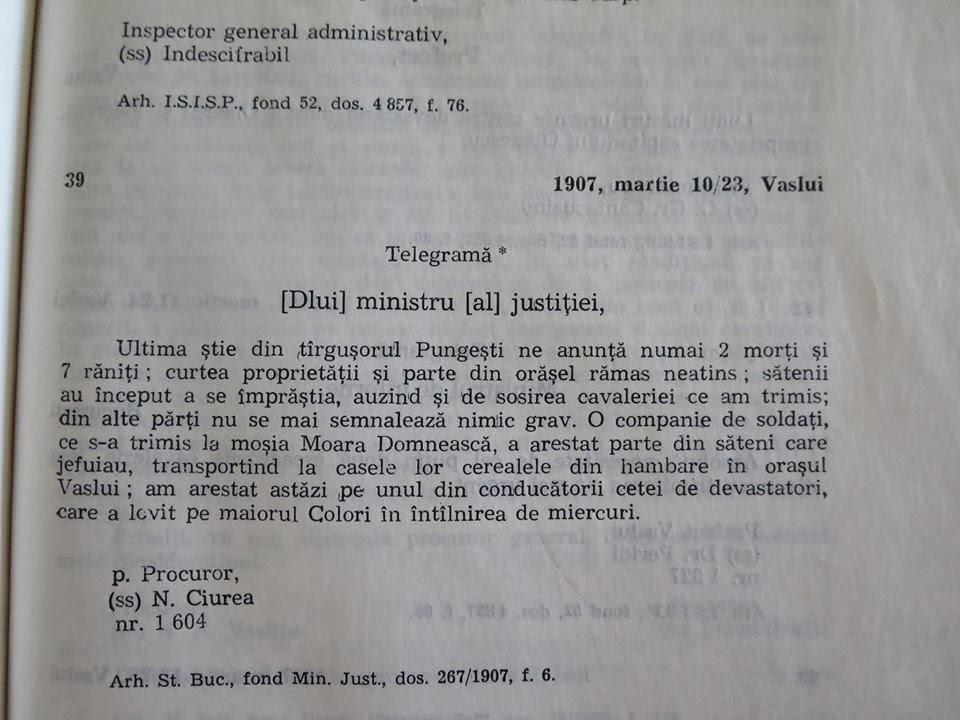
Now, from the point of view of my project, this topical anti-fracking protest in Pungești is relevant in more than one way. While working on documents relating to the 1907 peasant uprising in Romania, I came across several telegrams about Pungești as one of the hotbeds of rural unrest in Moldavia at the time:

Telegram from local landowner to the Minister of the Interior: 'The market town of Pungești, my mansion and farm under threat by peasant gangs; went there on hearing about the devastation of Negrești and other places; please give orders to send in the army to prevent devastations and killings'
Prosecutor's telegram to the Minister of Justice: 'The latest news from the market town of Pungești: only 2 dead and 7 wounded; the mansion courtyard and part of the town - untouched; peasants starting to disperse, having heard of the coming of the cavalry. Nothing serious elsewhere. A company of soldiers, who were sent to the Moara Domnească estate, arrested some of the peasants who were looting, carting cereals from the barns to their homes in Vaslui; we arrested today one of ringleaders of the band of devastators who hit Major Colori during the meeting yesterday.'
Vaslui Prefect's Telegram to the Minister of the Interior and War Minister: 'Peace and quiet in the whole county. Yesterday the fire at Mr Lascanu's property in Drăgușeni was accidental. On 22 march troops crossed over, without notifying us, into the commune of Poplana, of Tutova County, into the hamlet of Rahova, of the commune of Pungești, which belongs to our county, in order to arrest peasants suspected of devastation; the troop shot at some fugitives and killed a gypsy peasant; the local law court is investigating the case.'

It would be wildly unscientific to posit a continuity of peasant feistiness and rebelliousness across more than a century. The people that rebelled in 1907 in Pungești may not even have descendants (or do they?) among the 2013 protesters, they had a different agenda and lived in a completely different world from our own. There are however a number of striking structural commonalities: although the 1907 peasants were reacting against an oppressive system of land tenure and the 2013 peasants are reacting against an existential environmental threat posed to their livelihood by a multinational company, in both cases the source of the oppression are capitalist outsiders backed up by the State (the arendași, or estate administrators, in 1907; the Chevron multinationals in 2013). In both cases, the State is too blindly corrupt to realize or to act upon the realization that this way of governing a country is in the long run untenable, that it builds up social tensions which are bound to blow up one day. The State sent in the army (1907)/the gendarmes (2013) to 'pacify' the local population in the name of a legal framework which the same State has hollowed out of all meaning and all true authority.


How the Idea of This Project Came About


It all started with an interest in the issue of communication and cognition: how do people learn about violence elsewhere? What is the dividing line between knowledge and rumour? How does that information filter through? Does everybody understand the same thing as the others? Are there multiple readings of the same event? Do people understand what they want to and not necessarily what is being conveyed? Is this a dialogue of the deaf? What does the threat of violence and contamination do to other national/ethnic/social groups? How do they react?